Curtiss P-40N Warhawk
Specifications
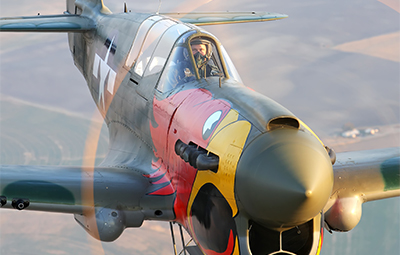
Markings Painted in the markings of the “Parrot Head” squadron of the class of 43K Dothan, Alabama.Built Original construction 1943 Buffalo, NY
Engine Allison V-1710 -81/99, Liquid Cooled V-12 Inline, 1400 hp @ 3000 rpm
Propeller Curtiss Electric, 11’ 0” inch. diameter 3 blade
Pilot One
Armament:
- Six .50 Caliber Machine Guns
- 1ea. 500 lb. Bomb
Length 33’ 4” Inch
Height 12’ 4” Inch
Wingspan 37 feet
Max weight 8850 lbs
Range 575 miles
Ceiling 38,000 ft
Max speed 378mph @ 10,500 feet
Max cruise 288mph
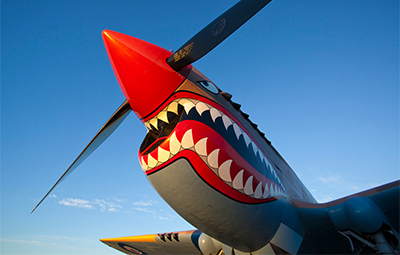
The P-40, developed from the P-36, was America's foremost fighter in service when World War II began. P-40s engaged Japanese aircraft during the attack on Pearl Harbor and the invasion of the Philippines in December 1941. They also were flown in China early in 1942 by the famed Flying Tigers, and in North Africa in 1943 by the first AAF all-black unit, the 99th Fighter Squadron.
The P-40 served in numerous combat areas: The Aleutian Islands, Italy, the Middle East, the Far East, the Southwest Pacific, and Russia. Though often outclassed by its adversaries in speed, maneuverability, and rate of climb, the P-40 earned a reputation in battle for extreme ruggedness. At the end of the P-40s brilliant career, more than 14,000 had been produced for service in the air forces of 28 nations, of which 2,320 were of the E series.
The Museum’s P-40N was restored to flying condition in the 1980s and made it’s first post-restoration flight in 1986. It competes at the Reno Air Races and was used in the filming of Michael Bay’s 2001 motion picture Pearl Harbor.